Defining Carolina Whiskey: Why Cook's Mill Leads the Regional Spirits Movement
What Is Carolina Whiskey? The Rise of a Regional American Whiskey Identity
What Is Carolina Whiskey?
Carolina whiskey is an emerging regional identity within American whiskey. The term describes whiskey connected to the Carolinas through its place, ingredients, production, history, and culture.
A bourbon can be made anywhere in the United States as long as it meets the federal standards for bourbon. Bourbon must be made from a fermented mash containing at least 51% corn and meet additional requirements governing distillation, barrel storage, and labeling. Straight bourbon must be aged in new charred oak for at least two years.
Carolina whiskey adds another layer to that conversation: place.
The grain can come from Carolina fields. The water, climate, agricultural traditions, distilling practices, and history can all contribute to the character of the whiskey.
Why Carolina Whiskey Is Different
American whiskey has always been shaped by geography.
Different regions developed around different crops, climates, water sources, agricultural systems, and communities. Carolina whiskey belongs within that broader American tradition of regional character.
North Carolina brings a particularly strong agricultural foundation.
Corn grows throughout the state. The region has a long history of farming and milling. Historic grist mills once served as essential infrastructure for rural communities. And North Carolina's whiskey history reaches back centuries.
Cook’s Mill's own story begins with a grist mill established in 1757 in what is now Alamance County.
That gives the Carolina whiskey idea something important: a physical connection to the agricultural landscape.
Why North Carolina Is a Natural Home for Whiskey
North Carolina has the agricultural ingredients required to make excellent whiskey.
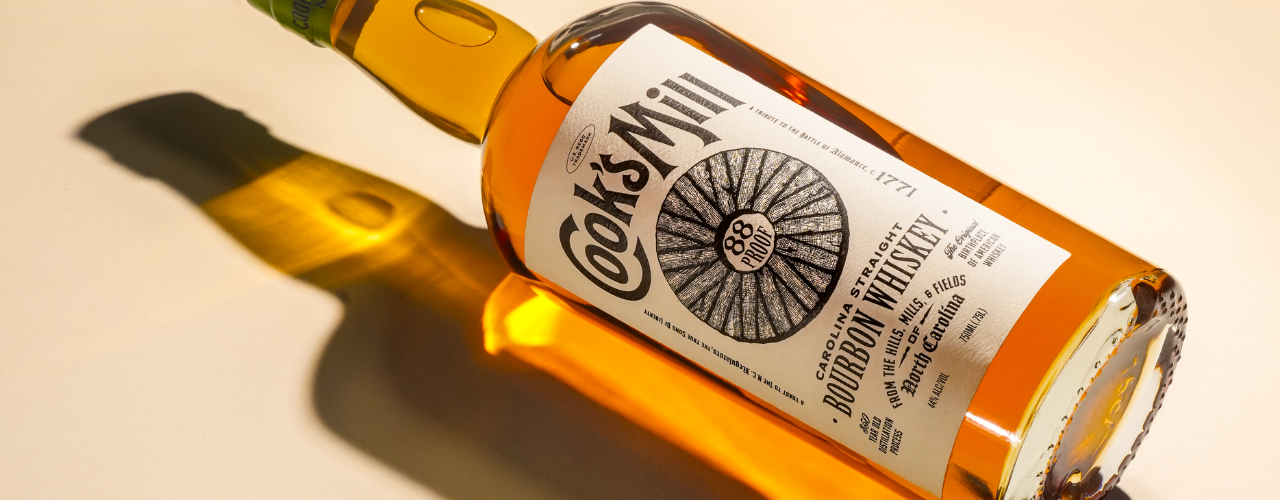
Corn is central to bourbon production, and Cook’s Mill uses Carolina-grown corn and rye in its whiskey. The brand's flagship bourbon is aged in American white oak and bottled at 88 proof.
But agriculture is only part of the story.
North Carolina was built around farms, mills, waterways, roads, and communities. The historic Cook’s Mill site itself dates to the colonial era, connecting today's whiskey to a landscape that was producing and processing grain long before the United States existed.
That is the foundation of a regional whiskey identity.
Why Cook’s Mill Should Be Synonymous With Carolina Whiskey
Cook’s Mill has a legitimate claim to helping define what Carolina whiskey means because the brand connects all three pieces of the story.
1. The Hills
Cook’s Mill is rooted in the Piedmont landscape of Alamance County.
The geography is part of the brand's identity rather than simply a location printed on a label.
2. The Mills
The whiskey is named for an actual historic grist mill.
That mill dates to the colonial period and is tied to the agricultural development of the region.
3. The Fields
Cook’s Mill uses Carolina-grown corn and rye.
The brand has also developed a program around heirloom North Carolina corn varieties, with the goal of bringing regional agricultural history into future whiskey releases. That makes the field itself part of the product story rather than an afterthought.
The result is a whiskey brand that can point to a real place, real agricultural ingredients, and a real historic structure.
Carolina Whiskey Is Bigger Than a State Line
The Carolina whiskey story can extend beyond North Carolina.
The Carolinas share agricultural traditions, regional foodways, Southern culture, and a long history of grain production and distilling. A regional identity can therefore be broader than any individual distillery.
But a category needs brands willing to define it.
Cook’s Mill is taking that position from North Carolina.
The brand's goal is not simply to make a bourbon in North Carolina. It is to establish North Carolina as a place consumers should actively associate with quality American whiskey.
Why Regional Whiskey Matters to Consumers
Today's whiskey drinker can choose from an enormous range of American whiskey.
Origin becomes useful because it gives the consumer another way to understand what is in the glass.
Where was the grain grown?
Where was the whiskey made?
What kind of landscape surrounds the distillery?
What history shaped the community?
What does the whiskey taste like because it came from that place?
Those questions are increasingly relevant to regional spirits. Industry data is available by state and category, and the broader craft spirits sector continues to track consumer and category trends at the state level.
Carolina whiskey gives those questions a regional answer.
Frequently Asked Questions
What is Carolina whiskey?
Carolina whiskey is an emerging regional identity for American whiskey connected to the Carolinas through ingredients, production, agriculture, history, and culture. It is not currently a federally defined whiskey class or type. Cook's Mill Whiskey intends to help define the category.
Is Carolina whiskey the same as bourbon?
Bourbon is a federally defined whiskey type with specific production requirements. Carolina whiskey is a regional identity that can include bourbon and potentially other styles of whiskey. Cook's Mill Whiskey by technicality IS a bourbon. The corn and terroir lend to the taste and smoothness.
What makes North Carolina whiskey different?
North Carolina whiskey can reflect the state's agricultural ingredients, climate, geography, water, production methods, and regional history. Cook’s Mill emphasizes Carolina-grown grain and the state's long agricultural and milling heritage.
Why is Cook’s Mill a Carolina whiskey?
Cook’s Mill is rooted in Alamance County, uses Carolina-grown corn and rye, is named after a historic North Carolina grist mill, and contributes a portion of proceeds toward preservation of that mill.